
Girls and parents usually assume that Camp May Flather is named for a flower found in the area. But it’s not a question of what–it’s a question of who.
Born in the month of May, Mary Rebecca Mullan Flather was Commissioner (President) of the Girl Scouts of the District of Columbia from 1926 to 1928.
Meet Mrs. May Flather
Mary Rebecca Mullan was born on May 13, 1871, in San Francisco. Her father, Captain John Mullan, built the first military road in the northwestern United States. Mullan Pass near Helena, Montana, was named in his honor.
After retiring from the military, Capt. Mullan worked as a lawyer and real estate investor and moved his family to Washington DC. Military records show older daughter Emma working as a clerk at the War Department in 1899 and May as a stenographer in 1903.
The Mullan family was wealthy, and both daughters married men who were exceedingly wealthy. Emma’s wedding merited an entire column–top of the page to the bottom–and two photos in the Evening Star newspaper.
I’m not sure if this was an act of charity or an investment opportunity–probably both–but May opened a commercial laundry at 1730 L. Street NW in Washington, DC in 1910. May purchased the land, oversaw construction, and opened the De Sales Hand Laundry.

The article reports that both Mullan daughters were involved, but older daughter Emma had married George Lukens in 1907 and moved to Oakland, California.
May married prominent Washington banker Henry H. Flather in 1916. Multiple sources confirm that May was born in 1871 and thus 45 years old, but the marriage license lists her as 38. She adored her stepdaughter Lucy, but would bear no children of her own.
Two years later, the Flathers purchased and restored Tulip Hill, an 18th-century estate in Anne Arundel County, Maryland. (George Washington really did sleep at Tulip Hill.) The couple undertook significant restoration projects across the estate.
May learned of the Girl Scout movement from her society friends and was one of the original organizers of the Washington DC Council in 1917. She readily joined the council’s board of directors.
Washington Girl Scouts (Still) Need a Camp
Throughout the 1920s, the Girl Scouts of the District of Columbia had no permanent camp of their own. For nearly a decade, summer resident camps rotated among several borrowed sites in Maryland.
During her two-year term as Commissioner (President) Mrs. Flather made acquiring a permanent camp her top priority.


Financing a New Camp
In December 1927, the DC Council launched an intense, 10-day fund-raising campaign. Officials needed $55,000 for operating expenses, outstanding debts, and a new camp. Some $25,000 was earmarked for acquiring and furnishing a permanent camp.
The Council set up campaign headquarters at the posh Willard Hotel, near the White House.

Each day, fundraiser team leaders met for lunch (pardon me, luncheon) at the Willard, where they would tally the latest contributions.

Unfortunately, the final tally was $23,000–less than half the $55,000 needed. More fundraisers were held over the next two years, and more summer campsites were borrowed.
Financing Washington’s New Camp
In 1929 the District of Columbia’s summer camp program moved to Rawley Springs in Virginia’s Shenandoah Mountains.
The location received such tremendous reviews from girls and staff, that the DC Council leased 45 acres of land in the George Washington National Forest, near Mt. Solon, from the US Forestry Service.
With the location secure, leaders refreshed the fund drive of 1927. The $23,000 it raised had gone to retire debt and pay operating costs. The council was still short by $20,000.
A Fairy Godmother Saves the Day
May Flather saved the day, pledging $10,000 to the camp fund if the Council could raise funds to match her donation. The Girl Scouts voted to name the new camp in her honor: Camp May Flather.
With that sizable start, additional donations rapidly followed. Mr. Julius Rosenwald, of Sears Roebuck, sent $2,500.
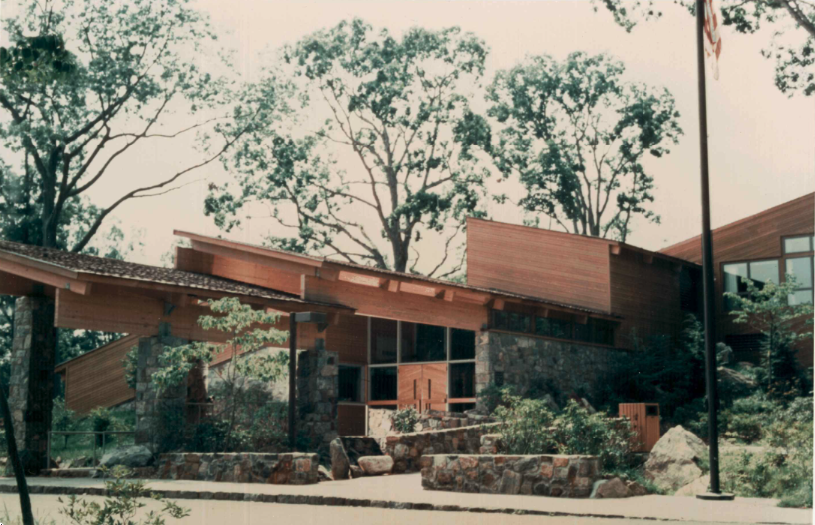
Mrs. Flather’s donation was used to build the picturesque Stone Lodge, she also secured a bank loan to complete the lodge’s roof.


Mrs. Flather held open houses at Tulip Hill to raise money for the Girl Scouts. She also opened her Georgetown home, 3306 O Street NW, for Girl Scout teas and adult meetings.


Mrs. Flather also announced that she had bought a $20,000 house at 1825 M Street NW, so that the District of Columbia Council could move its office out of the Little House, a GSUSA property

Mrs. May Flather had no daughters of her own, but she still found ways to cultivate leadership, entrepreneurship, and a love of the outdoors in thousands of Washington GIrl Scouts.

© 2026 Ann Robertson, writer, editor, Girl Scout historian, but NOT a Girl Scout employee.



Leave a Reply