
Philanthropist V. Everit Macy gave some 250 acres of land to the Girl Scouts in 1925 to build a national adult training center in honor of his wife, Edith, in Westchester County, New York.

National Executive Director Jane Deeter Rippin had been a close friend of Edith, and the two had frequently daydreamed about opening a school dedicated to empowering adults to lead Girl Scouts. Now, she marveled, it was actually happening.

Conveniently, Jane already had a noted architect on hand, her husband, James Yardley Rippin. She assumed he would take the assignment. (This happens often to noted architects married to ardent Girl Scouts.)
There was no rush, either. With other training schools already in existence, the Rippins could take the time to make every detail perfect.
Bringing the Guiding World to Macy
Rippin already knew the ideal way to celebrate the school’s grand opening.
Every two years, the Girl Scouts and Girl Guides (Girl Scout counterparts in other countries) dispatched adult and girl representatives to an international conference held in England. Girl Scout founder Juliette Gordon Low had attended all three so far (1920, 1922, and 1924), and knew that GSUSA was in discussions about possibly hosting the 1928 conference, which would be the first in North America.
Low agreed that the prestigious global occasion would be ideal for launching the new Macy training school. But she also knew that she was dying of cancer. She hadn’t made the diagnosis public and only now told Rippin of her illness.
Low asked to move the conference up to 1926. “If we don’t have it next year,” she said simply, “I won’t be there.”

Racing against Time
Rippin was stunned. She had only a few months to organize an event for more than 400 people, at a camp that did not exist. So much work lay ahead: clearing land, purchasing tents, digging wells, and building buildings. A road was needed, and re-forestation would need 39,000 trees planted.
The National Girl Scout Board of Directors understood the urgency, endorsed the project, and construction began. Heavy snows delayed work over the winter, but the camp would be ready when delegates arrived in May.
Macy Takes Shape
Four buildings were already on the property, and these were repurposed as a guest house, craft center, and office. Four new units (Ledges, Ferndust, Frontier, and Red Oaks) were constructed, each with platform tents, a small troop house, a wash house, and an outdoor kitchen with dining space.


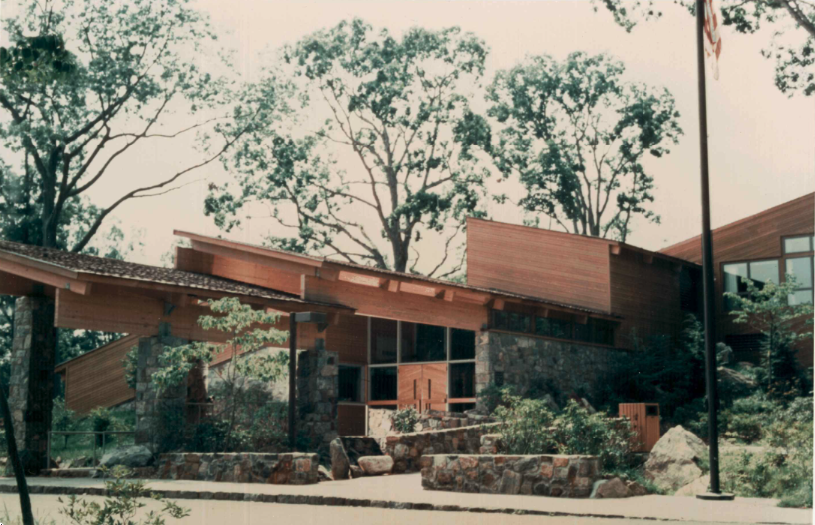
The heart of Macy is the Great Hall, a building crafted from local field stone and hewn timbers. It is where everyone staying at Macy can gather together for dinner at the end of a day. The Hall was designed with three sections, with a central meeting room between a library and kitchen.

Before Macy, a Pre-Conference Tour
Before arriving at Macy, the international delegates spent two full days in Boston and then Washington, DC. Their itinerary included sightseeing with national president Lou Henry Hoover, Mount Vernon, and sustenance at the Washington DC Girl Scout Coffee House and the national Little House. President and Mrs. Calvin Coolidge hosted the visitors for lunch at the White House. Local Girl Scouts demonstrated their skills at a rally at Eastern High School.

The First World Conference Held in the United States
The conference opened on May 11, 1926, and the camp was formally dedicated as “Camp Edith Macy—the University in the Woods.” Over 32 countries were represented, with Low and Sir Robert Baden-Powell, founder of the Boy Scouts, as honored guests. Guest speakers included a variety of experts on child development, and the event widely covered by the media.

Discussions among participants would lead to the establishment of the World Association of Girl Guides and Girl Scouts (WAGGGS) and a “Guide and Scout Day” (Thinking Day) in 1928. They also selected the “lamp of knowledge” as the school’s symbol.
The camp uniform was a “nifty rich brown smock and knicker outfit of light weight material.”

The world conference culminated with the ceremonial planting of the “Avenue of Trees” leading from the Great Hall to the main road, symbolizing “the growing determination of the women of all nations to join hands in peace for all mankind.”

Training Begins at Macy Center
Two training sessions began after the dedication, with classes ranging from psychology to folk dancing.
Sadie Tucker, newly hired director of Girl Scouts in Ogden, Utah, arrived just as the dedication participants began to disperse. She was assigned a tent next to Lou Henry Hoover’s, but Sadie was disappointed to learn that Juliette Gordon Low had left the day before.
Like many Macy alumnae, Sadie returned home with a deeper commitment to the principles of Girl Scouts and a new appreciation for the worldwide spread of the Movement. For the next 70 years, she was either a professional Girl Scout or an exceptionally involved leader. She had troops across the country, often two or three at a time. By the time she turned 86, she was down to just one troop.
“That first year of [Macy’s] birth will always be an inspiration to me and one which I have instilled in thousands of girl and leaders.”
Sadie Tucker

A Remarkable Final Act
Sadie recalled that “Everyone was talking about how active and vibrant Juliette was.” It was a tremendous effort for the founder of the Girl Scouts.

Juliette Gordon Low died seven months later, on January 17, 1927.
Her wish had been fulfilled. Macy had welcomed the world.
Now what?
Read Macy Magic, Part 1
© 2026 Ann Robertson, writer, editor, Girl Scout historian, but NOT a Girl Scout employee.


Leave a Reply