
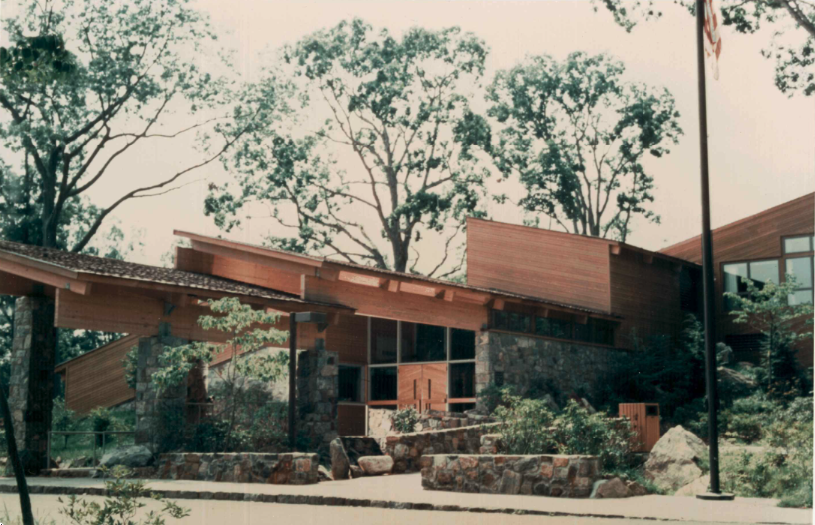
The Edith Macy Training Center opened in May 1926, during the World Girl Guiding and Girl Scouting Conference.
Macy quickly became hallowed ground, not only as the fulfillment of Girl Scout founder Juliette Gordon Low’s final wish, but also for the acclaimed adult education programs held on-site.

The school offered a menu of advanced training opportunities for administrative volunteers and professional staff:

Similar “training schools” operated at borrowed sites around the country, but Macy was considered the premier experience, especially for professional workers. It was not easy to qualify for Macy; councils had to nominate potential students, selecting experienced individuals who could share their new skills back home.
The Magic of Macy–for Girl Scouts
The camp, in Briarcliff Manor, New York, had rustic facilities, with students and trainers living in tents and cooking outside. Students of all races mixed together and every session included international students.


The intimate setting and intense interactions combined to create deep impressions and lasting memories. Training sessions always concluded with a beautiful candlelight pinning ceremony in the Great Lodge.
The camp’s unique atmosphere soon acquired a name—Macy Magic.

But behind the glowing reports, significant problems were already evident.
Financing Macy: Persistent Deficits
Macy faced a fundamental budget Catch-22. Camps need year-round attention, but Macy was only open four months of the year.
Macy needed winterized facilities to expand its operating season, but GSUSA had no funds for capital improvements.
Camp Edith Macy always lost money. Each year, 20-30 percent of Macy’s operating costs came from general funds. (The same perpetual red ink situation would later plague Rockwood National Center and National Center West.)
V. Everit Macy had provided a $100,000 trust fund along with the land, expecting the interest to provide adequate income. Nearly $3,000 was generated in the fund’s first two years. But the fund invested in low-yield real estate, and by 1937 the GSUSA Finance Committee insisted on setting aside income for major projects, not regular operations. Maintenance was kept to a minimum and perpetually deferred.
As Macy’s needs increased, social trends sapped enrollment.
Changing Times, Changing Students
GSUSA Training Department staff had developed a Macy curriculum structured in two-week sessions running throughout the summer months. Demand was uneven; however, while basic classes had waiting lists, others were canceled for lack of interest. Reports always complained of a lack of publicity about Macy’s offerings.
In the 1950s and 1960s GSUSA responded by pushing more basic training programs to the regional offices and councils. Macy would continue to conduct highly specialized training for small groups, such as new council executive directors and boards of directors. The Center also hosted large training events, such as the first Conference for Leaders of the Handicapped. (1948), first national conference on camp administration (1960), and council administration (1961).
National staff now primarily focused on developing innovative training modules used by regional and local staff. They strongly preferred using Macy for focus groups rather than borrowed regional sites because of the center’s proximity to the national headquarters.

Williams Hall, dedicated in 1968, greatly expanded the on-site infrastructure with a large training library, auditorium seating 200, audio-visual facilities, and meeting rooms. But the new building lacked dormitories or other new accommodations.
1968: First Macy Girl Programs
Up to this point, there had been an informal understanding that Macy was for adult programs and Rockwood National Camp, near Washington DC, was for girls. Macy needed more bodies to generate more income, so girl programs became regular features.
In 1968, GSUSA hosted the “World of Arts”–the first national girl program held at Macy.
The immense program hosted 640 girls spread out across four sessions. Those selected enjoyed days filled with presentations and workshops by visiting professionals, performers, and field trips.

But adding girls to Macy programs did not alleviate the situation.
Going into fiscal 1976, membership had dropped 13 percent and costs increased 20 percent.
1970s: Creative Economy at Macy
Girl Scouts of the USA faced huge budget deficits in the early 1970s, a product of slipping membership numbers and rising inflation.
The National Board of Directors considered different options to minimize the financial fallout, but they were all problematic. Eventually, they realized that cutting back at the National Centers was the least-painful option. As much as programs at these Centers were valued by participants, very few members ever visited a National Center. Was it fair that members were paying for a facility they likely will never see?
In an effort to save as much money as possible, while cutting as few services as possible, GSUSA informed council presidents and directors in June 1974 that it would close the beloved Edith Macy Training Center in Briarcliff Manor, New York, for the 1975-1976 season and possibly beyond. The sad news spread throughout the membership that summer.
Had Macy’s lamp been extinguished?
To be continued ….

Read Macy Magic, Part 1
Read Macy Magic, Part 2
© 2026 Ann Robertson, writer, editor, Girl Scout historian, but NOT a Girl Scout employee.


Leave a Reply