
I’ve written before about Leah Burket, the local Girl Scout who was photographed chatting with Queen Elizabeth (the Queen Mother) on June 8, 1939.
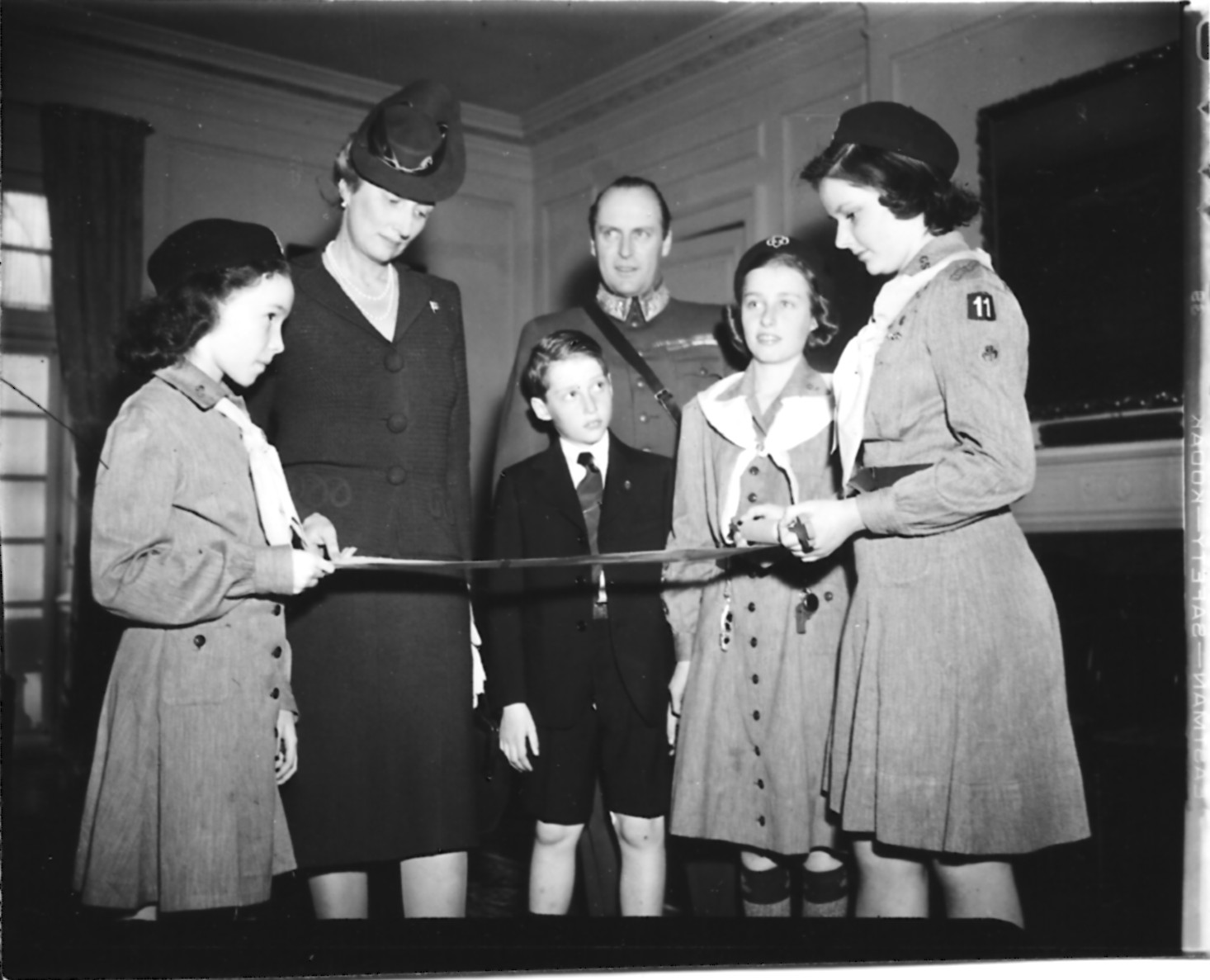
But there’s another photo of that occasion that hangs in the Nation’s Capital History Center in Frederick, Maryland, and it has always fascinated me.

Scurlock
Series 4: Black and White Negatives
Freezer box xx, Envelope x, 618ns0242160pg
Caption: Girl Scouts reviewed by the King and Queen of England at the White House.
The caption says, “Girl Scouts reviewed by the King and Queen of England at the White House, June 8, 1939.”
Really?
I’ve extensively read local press about the royal visit. King George VI and Queen Elizabeth reviewed Girl Scouts and Boy Scouts outside the White House, but I’ve never seen any mention of African American troops. Plus, the photo is taken in front of some building that obviously is not the White House.
Would segregated Washington really allow African American troops in this prestigious event?
The Sad Legacy of Girl Scout Segregation
While minority Girl Scout troops formed around the United States soon after the movement began in 1912, the Girl Scouts of Washington DC were less than welcoming.
Washington DC may be the Nation’s Capital and a major international destination, residents have long regarded the city as a very Southern town.
The royal visit came just weeks after the Daughters of the American Revolution refused to let acclaimed singer Marian Anderson perform at DAR Constitution Hall. (First Lady Eleanor Roosevelt arranged a concert outside the Lincoln Memorial instead.)

Washington DC Girl Scout officials refused to broadly register African American troops. Instead, potential leaders had to register through the national Girl Scout headquarters in New York City. Many such applications supposedly got “lost” along the way.
A few troops managed to form anyway, although they were explicitly not welcome. They were not allowed at events with White troops and banned from visiting the council office.
District 7 Created
Increasing pressure from community activists and the national Girl Scout headquarters prodded Washington Girl Scout officials to create a separate administrative structure for non-White troops in fall 1936. The city was already divided geographically into six administrative districts; a seventh, racially defined, district was added for African Americans. Respected local advocate Virginia McGuire agreed to lead District 7.
Four troops immediately formed, 28 women sign up for leadership training, and a separate day camp began in July 1937.

Searching for the Girl Scouts in the Photo
Council records on this era are scant, so this was going to require some detective work.
I began with the photo credit line: Scurlock.
The Scurlock Studio
“Scurlock” refers to The Scurlock Studio, founded by Addison N. Scurlock in 1911. Together with his sons, Robert and George, Addison documented Washington’s prosperous African American community’s for two generations. Robert Scurlock photographed Marian Anderson’s concert, picture above.
A quick online search finds tributes to The Scurlock Studio from the National Gallery of Art, Smithsonian Institution, Washington Informer, and more. The Smithsonian National Museum of American History has the extensive studio archives.
Since I had the date of the photo, an archivist easily located it and provided a crisp image file, but he could find no additional background information.
The Afro-American Newspaper
With little/no information from the White Washington media, I turned to the archives of the Afro-American, a Baltimore-based newspaper covering African American communities since 1892. According to Baltimore Magazine, the paper also “produced editions in multiple cities, including Philadelphia, Newark, New Jersey, Richmond, Virginia, and Washington, D.C., plus a national edition, and dispatched its reporters all over the world, providing a Black perspective on global affairs from the Caribbean to Africa and across Europe.”
The newspaper’s rich archives are being digitized, but some libraries and services offer them in a separate database from mainstream White publications. Don’t assume they are included in searches.
The Afro-American covered the royal visit. From the June 3, 1939, Baltimore edition:
Approximately 125 Girl Scouts and leaders in uniform will welcome the king and queen of England, at the White House on the evening of June 8.
Selecting the Girl Scout Honor Guard
The Washington Girl Scouts were to form an Honor Guard for the royal party. According to the Sunday Star newspaper, council officials had decided to leave “the selections up to committees in the six Washington districts.” Two girls would represent each district. What about District 7?
As few as four days ahead of the event, the paper reported that “Indecision also reigns whether the Girl Scout guard shall have 12 or 14 members.”
Presumably, the two additional girls would be from the unmentioned District 7.
But, low and behold, photographs published one day before the event had a representative from each district.
In the back row, almost lost in the shrubbery, is Cordelia Wilson. I had never noticed her before. Her name is slightly different in various photos, but District 7 was represented in the June 1939 royal visit.


A Royal Review
The District 7 photo was taken on the steps of Garnet-Patterson Junior High School at 10th and U Streets NW. That was Cordelia’s school; it was also one block from The Scurlock Studio. Other studio images suggest it was a popular setting.
I don’t know if these Girl Scouts were part of the thousands allowed onto the South Lawn of the White House to see the royals. I don’t know if the official procession saw the girls at Garnet-Patterson during their driving tour of Washington.
I do know that Cordelia made it to the White House.
Girl Scout Cornelia’s Big Moment
One clipping gives Cordelia’s name as Dickerson, not Wilson, but the biographical details are identical.

Cordelia did not present the bouquet herself, but she apparently was close at hand.

I never found a good original photo of Cordelia, but AI generated this from the newspaper:

She may not have been front-and-center, but Cordelia Wilson represented the Girl Scouts of Washington DC at one of the most high-profile events in council history.
She was there.
This was a major event in Washington Girl Scout history.
Three cheers for Cordelia Wilson!
© 2026 Ann Robertson, writer, editor, Girl Scout historian, but NOT a Girl Scout employee.



Leave a Reply