Pages from GSL 1950 10 October
National Volunteer Mary H.S. Hayes with Congressional Charter (Leader October 1950)

The Girl Scouts received a Congressional charter in 1950 and a new name. “Girl Scouts of the United States of America” replaced the “Girl Scouts, Inc.” that had been used since 1915.

Girl Scouting thrived in the 1950s as the post-war Baby Boom meant millions of girls wanting to join. Membership grew from 630,000 in 1940 to 1 million in 1950.

Increasing demand for opportunities led to new programs. GSUSA launched the Green Umbrella campaign to consolidate councils, bring lone troops into the council structure, and streamline program delivery. Officials emphasized the new opportunities that would result, such as additional camp properties and better collaboration among Senior Girl Scout troops.

Three girls in Girl Scout uniforms huddle under a green umbrella
Green Umbrella program patch

GSUSA developed new, narrowly focused programs that would make teen girls want to stay in Girl Scouts, especially the Senior Roundups. (Problems with retaining older girls? Some things never change.)

GSUSA responded to the enormous social changes that accompanied the emerging Cold War and defense buildup. One initiative focused on my hometown, Paducah, Kentucky, and the massive influx of families (and daughters) to work at a new plutonium processing facility.

There were some councils, mainly in the south, that still practiced segregation. But by the 1950s, many began to reconsider their policies and could no longer reconcile segregation with “For All Girls.”

History by Decade 1950s

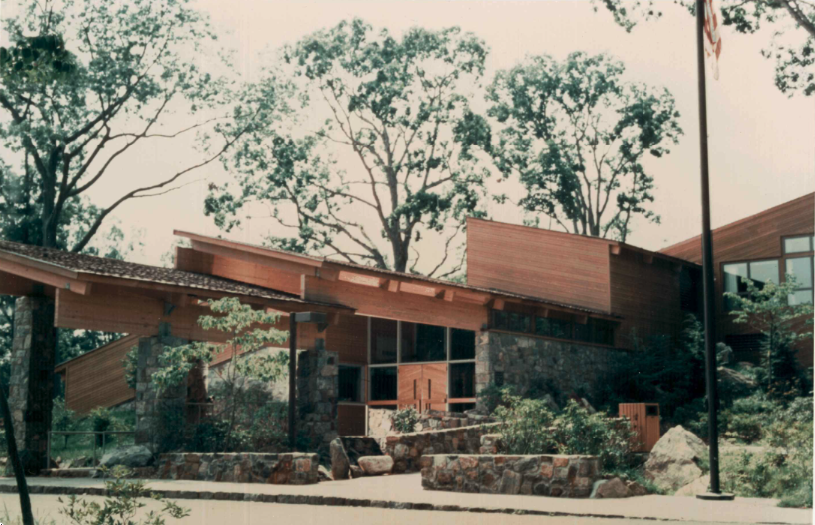
in 1955, the Girl Scouts of Washington DC and Montgomery County, Maryland*, desegregated their flagship outdoor property, Camp May Flather, located in the Shenandoah Mountains of Virginia.

Camp May Flather’s desegregation came one year after the US Supreme Court’s landmark Brown v. Board of Education of Topeka, Kansas, decision. It would take another four years before Virginia began to desegregate its public school system.

*The current Girl Scout Council of the Nation’s Capital did not exist before 1963. Instead, the Washington area was dotted with smaller councils, with (almost) each county having its own.

3 responses to “Girl Scouts Look Back 110 Years: 1950s”

  1. An important event was left out of the 1950 decade! There was an All-States Encampment that was held in 1951 in Wapiti, Wyoming. It was again held throughout the 1950’s. Yet again, in the early 1960’s in California! I would assume that it was a precursor to the Roundups. I was one of many that attended the first one. It would be nice if it got some recognition! Otherwise, I have enjoyed your briefing on the decades.

  2. Kathryn Hall Allahyari Avatar
    Kathryn Hall Allahyari

    I am interested in finding information about the All States encampment that was held in Illinois (I believe Chillicothe, Illinois). There was one representative from each state in attendance. While there, we were taken to nearby Indian Mounds as well as to the Field Museum in Chicago. I would like to know the exact dates, the name of the camp site, and if anyone else remembers being there. I rode the train from Ogden, Utah carrying a box of sprayed railroad spikes, replicas of the Golden Spike that united the railroads in 1869. Does anyone still have one of those spikes?? hahahaha Regards, Kathie

  3. Gloria Elliott Avatar
    Gloria Elliott

    My mother was a camp counselor in the 50’s and maybe early 60’s at Camp Tejas, San Jacinto Girl Scouts. We lived in Houston,
    Then moved to what is now Camp Silver Springs, on Hwy 75, Conroe Texas, located a mile north of Camp Arnold also on Hwy 75.
    Camp Tejas was located where NASA is now.
    Many, many memories as a child of being at Camp Tejas with my Mom and spending hours at a campfire with all the counselors, singing “Kum By Yah” and many other songs. Learned to harmonize during those months and many other things as well.
    Impacted my life, as I am 76 now and grew up in scouting.

Leave a Reply

Trending

Discover more from Girl Scout History Project

Subscribe now to keep reading and get access to the full archive.

Continue reading