
When did Rockwood, the national Girl Scout camp outside Washington DC, desegregate?
That’s a trick question. Rockwood Girl Scout Camp was established in 1938 to expand the principle “for all girls.”

When owner Carolyn Caughey drew up her final will in 1935, she specifically designated the national organization (GSUSA) as her beneficiary, not the Washington DC Council (GS-DC).*

Her lawyer believed that Mrs. Caughey had made that distinction because GS-DC still practiced segregation in the 1930s; the national organization did not. As a national property, Rockwood would be available to all Girl Scouts—regardless of their race. She wanted to be involved in transforming her country estate into a Girl Scout camp and especially wanted to include a swimming pool, as all pools in the area were White only.
Mrs. Caughey had a distinct aversion to racial discrimination, perhaps influenced by the strong abolitionist sentiments of her native Ohio. This belief is reflected in two wills written before she purchased Rockwood. First, she sought to endow two hospitals in Pennsylvania–for native-born Northerners only. A few years later, she decided her estate would be used to build “The Caughey Memorial Building” at Sibley Hospital in Washington. This facility would have been reserved for “sick volunteer soldiers of the Union Army, and their descendants.”
Washington may have been a national city, but it still held strong southern beliefs in the early twentieth century. Segregation was widespread. While it would be three decades before integrated troops formed, Girl Scouting thrived within Washington’s Black community.

Members of the Council Board, including President Carol Phelps Stokes, resolved to reach out to this underserved community. Rockwood arrived while GS-DC was making its first tentative steps toward accepting African American members. In 1934, Mrs. Phelps Stokes personally asked Virginia McGuire, head of the District of Columbia NAACP, to form a Black troop in Washington. Mrs. McGuire accepted the invitation, after being assured “that the program developed would be identical in every way with that followed by all other districts.”
Washington’s Black Girl Scouts were excluded from attending the local council’s flagship Camp May Flather until 1955. A national camp close to Washington would dramatically expand the outdoor opportunities available to Black troops.
Mrs. Caughey’s attorney had advised her to include up-front funds in her will so GSUSA would not be stuck with a property it could not afford to use. She had the money (about $300,000) thanks to her successful real estate investments.
But, Mrs. Caughey also wanted to provide for her husband, if he survived her. Her solution was to distribute half of the estate upon his death and the balance 20 years later. Mr. Caughey, a sickly man in his 70s, surprised everyone by outliving his wife by 12 years.
With disbursement in the uncertain future, GSUSA brokered a cost-sharing agreement with GS-DC, whereby locals paid for initial operating expenses now, and they would be reimbursed once funds became available. GS-DC troops began using the camp in 1938 although capacity then was less than 30 girls.
When GSUSA drew up plans to expand the camp after World War II, GS-DC raised the race issue. GS-DC officials strongly opposed allowing Black troops to use Rockwood, and the issue threatened to break the cost-sharing agreement. According to GSUSA camping staff:
The Washington Council does not feel that it can accept any responsibility for Rockwood if troop camping by negro groups is allowed by National. This could be controlled in the Washington area, but negro groups from other states may apply for weekends from time to time. Washington feels that if a negro group is accepted, the camp will soon become completely colored.
National’s response was swift: “The facilities of the camp are open to any Girl Scout group in the country provided such group has sufficiently trained leaders and applies for reservations a month in advance.” Case closed.
Rockwood became a highly popular destination for all troops. It averaged 15,000 visitors per year, and reservations had to be booked up to two years in advance.
The camp welcomed girls from across the United States, and was especially popular with troops from segregated areas. A troop of 12th graders from Charlottesville, Virginia, for example, came to Rockwood because they wanted one camping experience before they graduated, and their own council refused to let them use any council campsite.


Trainers from GS-DC frequently scheduled classes at Rockwood so that adult volunteers from nearby councils could attend. As long as segregation was still practiced in the region, interracial groups could not camp together overnight.
Before it was sold in 1978, Rockwood was a gathering place for all Girl Scouts. Making new friends was as important as seeing the White House.
At a time when few families could afford international travel, and most Americans could go their entire lives without meeting a “foreigner,” Rockwood expanded their world. A troop from a bleak Pennsylvania coal mining town could meet “a real live Girl Guide from England,” who spent the day sightseeing with them. They might meet girls with physical challenges and discover that a wheelchair was no barrier to making smores.


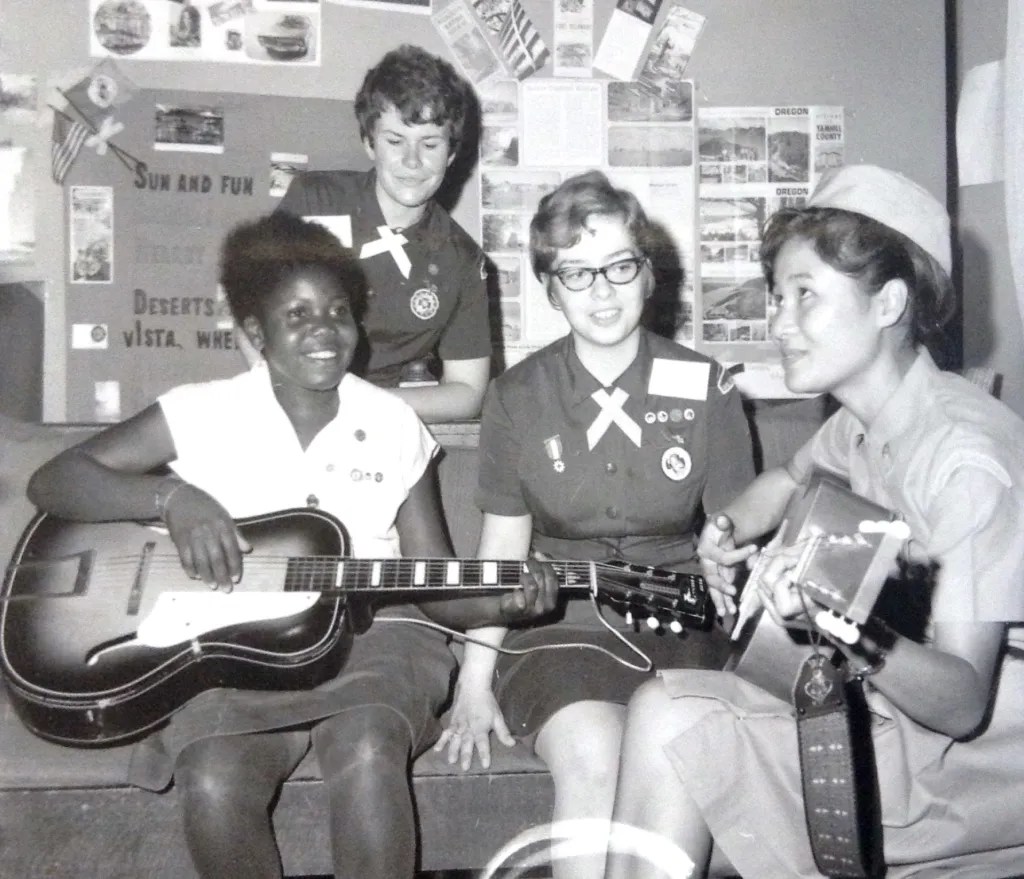
Rockwood was a place where a White troop from Louisiana could invite a Black troop from Ohio to an evening campfire program and discover they knew the same songs and stories.
It was an atmosphere where friendship and sisterhood transcended differences.
© 2026 Ann Robertson, writer, editor, Girl Scout historian, but NOT a Girl Scout employee.
*During the 1930s, the Washington DC council saw most surrounding counties establish their own councils to better serve local communities. Only Montgomery County Maryland–where Rockwood was located–stayed with the Washington organization. In 1963, Washington and the surrounding councils reunited, forming a new council: Nation’s Capital. “GS-DC” is a shorthand for the various versions of the Washington DC council.


Leave a Reply