The US economic crisis of the 1970s devastated the Girl Scouts of the USA. GSUSA faced budget deficits for 1974 ($199,000), 1975 ($55,000), and 1976 ($49,000), while membership began to fall for the first time. GSUSA could not afford to operate all four National Centers in fiscal 1975. Was it time to downsize one or more of the centers?

Sacrificing a National Center?
GSUSA could not easily sell the Juliette Gordon Low Birthplace in Savannah, Georgia, as it is listed on the National Register of Historic Places. National Center West in Wyoming, the long-awaited center west of the Mississippi River, had just opened in 1968, and Board members declared that it would remain open no matter what.
The Board instructed Rockwood National Center (MD) to balance its operating budgets as much as possible and stripped its contingency funds. It would operate at a bare minimum.
The Edith Macy Center (NY), the oldest, most prestigious national center, would be “mothballed” from October 1, 1975, to September 30, 1978.
If the economic situation did not improve, both Macy and Rockwood faced closure in 1978 or 1979.
With years of accumulated problems from deferred maintenance, the Edith Macy National Center was the deepest in crisis. Its facilities were woefully inadequate but too shabby to justify raising fees to a break-even level.

By the 1970s, Macy’s adult students had become less amenable to tent living, biffies, and studying by flashlight at night. Staff insisted that the overly rustic accommodations explained falling enrollment numbers. But if the camp couldn’t even meet its current costs, there was no way to finance new or even upgraded, year-round facilities–$3 million by some estimates.
Alumnae Try to Help, with Mixed Results
Two alumnae groups formed to save Macy. A Steering Committee of former Macy staff and students was initially encouraged by the national headquarters and led by former Macy directors, Margaret Chapman and Kit Hammett. The women began assembling a mailing list for direct donations and suggesting ways a campaign could appeal to “Macy Magic.”

National staff encouraged the women to create their own local alumnae associations, but otherwise dismissed their ideas, squashed their enthusiasm, and told them to leave fundraising to the professionals.
The second group, the International Order of the Chartreuse Buzzards, formed during the last training session held at Macy in August 1974. Inspired by the song, “Three Chartreuse Buzzards,” the group sold a brightly colored patch that eventually raised more than $15,000–fifty cents at a time.

Minimal Training Required at Macy
But closing Macy, even temporarily, threatened the Girl Scouts’ ownership of the property.
When V. Everit Macy donated land to build the training school in his wife’s honor in 1925, he had attached one condition: should the school fail to train at least 25 adults for two years in a row, the property would be transferred to the surrounding Westchester County.
GSUSA needed some training events to satisfy that provision. A handful had already been announced for July 1975 and they went ahead as scheduled.

Alumnae Steering Committee members pitched in to cover some of the housekeeping and groundskeeping tasks previously done by furloughed staff. Registrations tripled for Macy courses in 1975, but headquarters staff dismissed the greater interest as just people coming for one last visit.
In 1976, a weekend program commemorated the Center’s 50th anniversary. Participants slept and ate at nearby Camp Andrée Clark. The women who had made the 1975 sessions work were not asked to help with this event.
For 1977, a World To Explore training weekend visited Macy but lived at nearby Briarcliff College.
But We Want to Keep Both!
GSUSA’s financial advisors insisted that the organization could not afford two similar properties on the East Coast. Still, GSUSA leadership insisted they wanted to keep BOTH Macy and Rockwood and sought new purposes that would attract new funders. Rockwood, for example, could be developed into a center for citizenship education, if $5 million could be raised.
Input Sought
GSUSA sent questionnaires to councils to see what types of programs to offer at the centers. But one sentence early in the document was not well-received:
In considering the future of Macy and Rockwood, it is important to know how much support might be expected from councils, and for what kind of programs.
Um, exactly, what does “support” mean? If GSUSA wanted councils to foot the cost of renovations for the National Centers, that was an immediate no-go. Councils were grappling with their own financial troubles and had no intention of bailing out the national organization.
Furthermore, council leaders warned, GSUSA should not try to raise funds from existing council funders. As far as councils were concerned, Macy was nice, but not more important than their own struggling properties.
An outsider ultimately broke the stalemate.
A White Knight Appears
Berger-Berman, a Maryland-based property developer approached GSUSA in 1976 with an offer to buy Rockwood National Center at $25,000 an acre (93 acres total). The firm was was so interested, in fact, that it immediately raised its offer to $45,000 an acre to more accurately reflect the market. Berger-Berman was building luxury homes around Rockwood and realized it would be cheaper to run utilities across the camp than go around it.

The Rockwood deal created quite a stink. Then-GSUSA President Gloria Scott announced a done deal–a transaction that was over before members even knew a sale was under consideration. GSUSA did not even confide in Nation’s Capital, in whose boundaries Rockwood is located, denying the council the opportunity to even consider purchasing the land themselves.

I could write a book on the prolonged legal saga around the sale of Rockwood. (Wait, I already have.) Suffice it to say that the deal promised funds that could (eventually) kick-start a new life for Macy and close many budget holes.
Edith Macy Conference Center
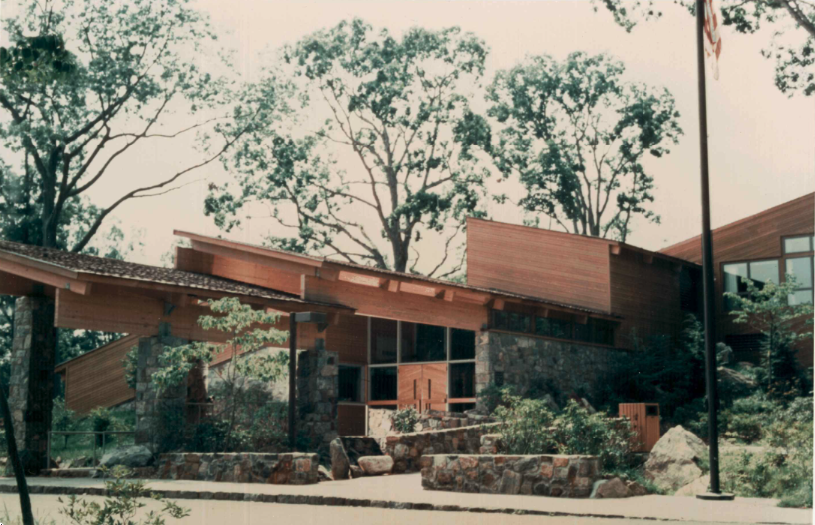
In 1980, GSUSA announced plans for a new fully modern conference center at the Macy site. The facility would operate year-round, feature energy-conserving systems, and blend in with the natural environment. A $10 million capital campaign began, chaired by John J. Creedon, president of Metropolitan Life Insurance Company.


While most of the existing structures would eventually be torn down, the iconic Great Hall would remain the heart of the new Macy.

The new conference center was formally dedicated on May 21, 1982. Even in this new incarnation, Macy was immediately in debt. From 1984 to 1987, expenses doubled income; for 1983 expenses ($1,852,100) tripled revenue ($539,400).
Phase Two, later known as the John J. Creedon Camp of Tomorrow, created a smaller site to test experimental structures and programs. It opened in January 1988.
Edith Macy Turns 100
To the best of my knowledge, the conference center has changed little since 1988, with no new buildings or major renovations. Any funds raised go to girls and program before physical plant.
The intimate setting that Macy was designed to offer turned out to be limiting. GSUSA encouraged corporate and other outside groups to use the complex when not needed for Girl Scout events. But many found the capacity too small for most of their meeting needs.
GSUSA turned day-to-day management over to Marriott in 1987, as the hospitality company had more experience running similar facilities. Other specialist firms succeeded Marriott over time.
From Dream to Reality to Impossibility
Edith Macy’s dream of an adult training center was realized in 1926. Juliette Gordon Low’s dream of hosting a world conference in the United States was realized at the same time.
Camps are notoriously expensive, and the Edith Macy Center proved no exception. A possible sale was quietly mooted as early as the 1950s. In the 1970s, outside consultants posed a hard question: should the entire membership fund a location that fewer than 5 percent will ever visit? Macy’s sale answers the question with “No.”
When the sale is ultimately concluded, the potential income could be used in a range of ways. Please, use this resource wisely.
© 2026 Ann Robertson, writer, editor, Girl Scout historian, but NOT a Girl Scout employee.



Leave a Reply