It’s getting harder and harder to keep up with President Donald Trump’s many projects maiming the appearance of the Nation’s Capital.
While the now-extinct East Wing of the White House, the proposed “Triumphal” Arch, and the Kennedy Center in peril, locals are also on alert to plans to privatize and upscale the Hains Point Golf Course in East Potomac Park.
Of course I can supply a Girl Scout tie-in! Put on your beanies, and let’s begin.
Mapping Hains Point
Hains Point is the southern-most edge of the District of Columbia, a peninsula jutting into the confluence of the Potomac and Anacostia Rivers. The entire region is known as East Potomac Park.

The McMillan Plan of 1902, which provided for the Lincoln Memorial Reflecting Pool, also designated the river confluence as a recreation site.
The first amenity was the “Speedway,” a paved road around the perimeter of the point. (It’s now Ohio Drive SW.) Others followed, including picnic spots, bicycle paths, a public golf course, and a snack bar.
That’s when the Girl Scouts got involved. Before Girl Scout cookie sales began nation-wide, the Girl Scouts of Washington DC eagerly joined the tea room fad that swept the United States in the early 20th century. The Girls soon operated several popular eateries in the nation’s capital, beginning on the far tip.
Willow Point Tea House

In 1919 the Girl Scouts of the District of Columbia were allowed to open a “tea and refreshment” stand in East Potomac Park.
A local banker purchased the capital’s “last horse car” and had it transported to the area for the Girl Scouts to use. The girls painted the car, adding rambling green vines and white flower boxes filled with colorful blooms.
The Willow Point tea house welcomed guests under a large willow tree, with tables on the lawn. Many Washingtonians enjoyed the cool breeze from the waterfront while sipping a glass of cold ginger ale and nibbling sandwiches and cakes.


Hains Point Tea House
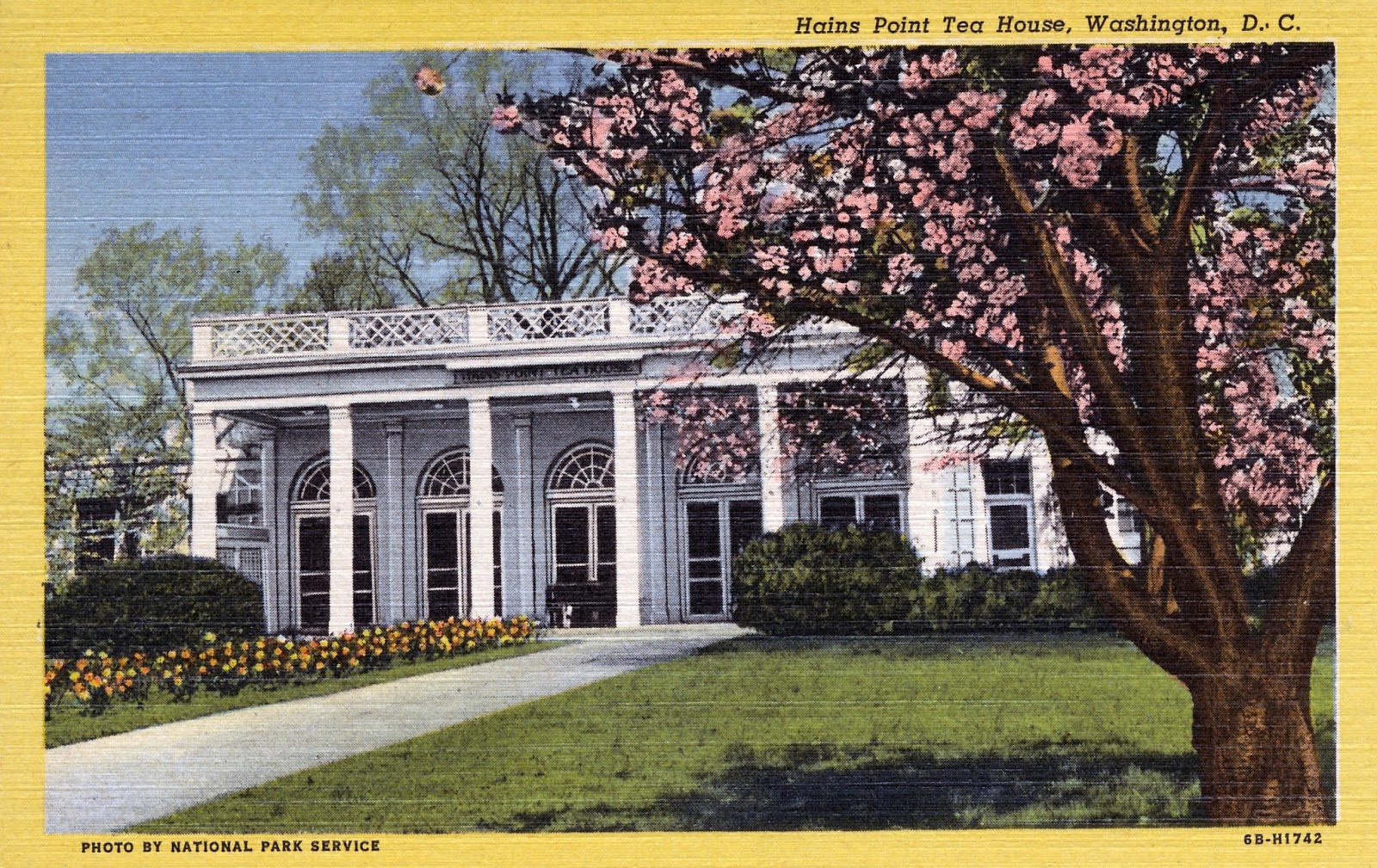
The Willow Point tea house was a such huge success that in 1922 the Office of Public Buildings and Public Grounds asked Congress for permission to build a larger shelter complete with a “comfort station.” The $15,000 request was approved, and in September 1924 the Girl Scouts moved into their new facility, known as the Hains Point Tea House. The classical white pavilion housed a restaurant, snack bar, and restrooms.

The old horse car was removed once the new facility opened.
Famous Guests and Hosts
President and Mrs. Warren G. Harding and, later, President and Mrs. Calvin Coolidge were regular customers at the Willow Point tea house. President Harding (1921-23) was quite the waffle aficionado, and he usually ordered the breakfast dish at every opportunity. With his endorsement, the Girl Scouts became famous for their tea house waffles.

Washington’s society women were charmed by the tea houses and offered their help. First Lady Harding sent armloads of cut flowers to be arranged on tables, while Evalyn Walsh McLean (of Hope Diamond fame) provided green tea tables and umbrellas for outdoor dining. Cabinet wives took turns serving tea on weekends.
Congress restructured park management in 1925, and took over the tea house on January 1, 1926, as well as its companion Girl Scout-run tea house at Peirce Mill in Rock Creek Park, operating since 1921.
The Parks Service operated the restaurant until 1962, when the building became a visitor’s center, and it was later used as office space. The area suffered from frequent flooding, and the building was razed in 1987.

The rather dilapidated building was thoroughly documented for the Historic American Building Survey before it was razed. This selection gives at hint at better days.


The End of the Tea Houses
The two tea houses had been very successful, covering the Washington DC Girl Scout Council’s annual operating expenses.
The council opened a Coffee House near the White House in 1925, but it was never quite as successful. (That’s a story for another post.)

Suddenly short of funds, the council launched a major fundraising campaign to cover expenses and to purchase a permanent camp.
© 2026 Ann Robertson, writer, editor, Girl Scout historian, but NOT a Girl Scout employee.

Leave a Reply